
Vermont communities are seeing a rapid increase in high-powered, high-speed, unregulated devices operating on streets, sidewalks, and shared use paths.
The problem is not with e-bikes. It is a different category of device entirely, what Local Motion and our national partners call "e-motos." E-motos have more powerful motors and are capable of significantly higher speeds than e-bikes, and often lack the ability to pedal entirely. The growing safety concerns we’re hearing across Vermont stem from the rise of these devices and their unclear legal status, not from the e-bikes Vermonters have long used responsibly.
The good news is that Vermont state statute already defines and regulates these devices. To address these emerging concerns, we need to expand education, regulate their sale, and enforce the laws already in place. Most e-motos are classified as motor vehicles, meaning they belong on the road, not the sidewalk. E-moto riders must be at least 16 years old, licensed, insured, and display license plates, just like any other motor vehicle. E-motos that fall outside these requirements are still prohibited on sidewalks and may not exceed 20 mph under law.
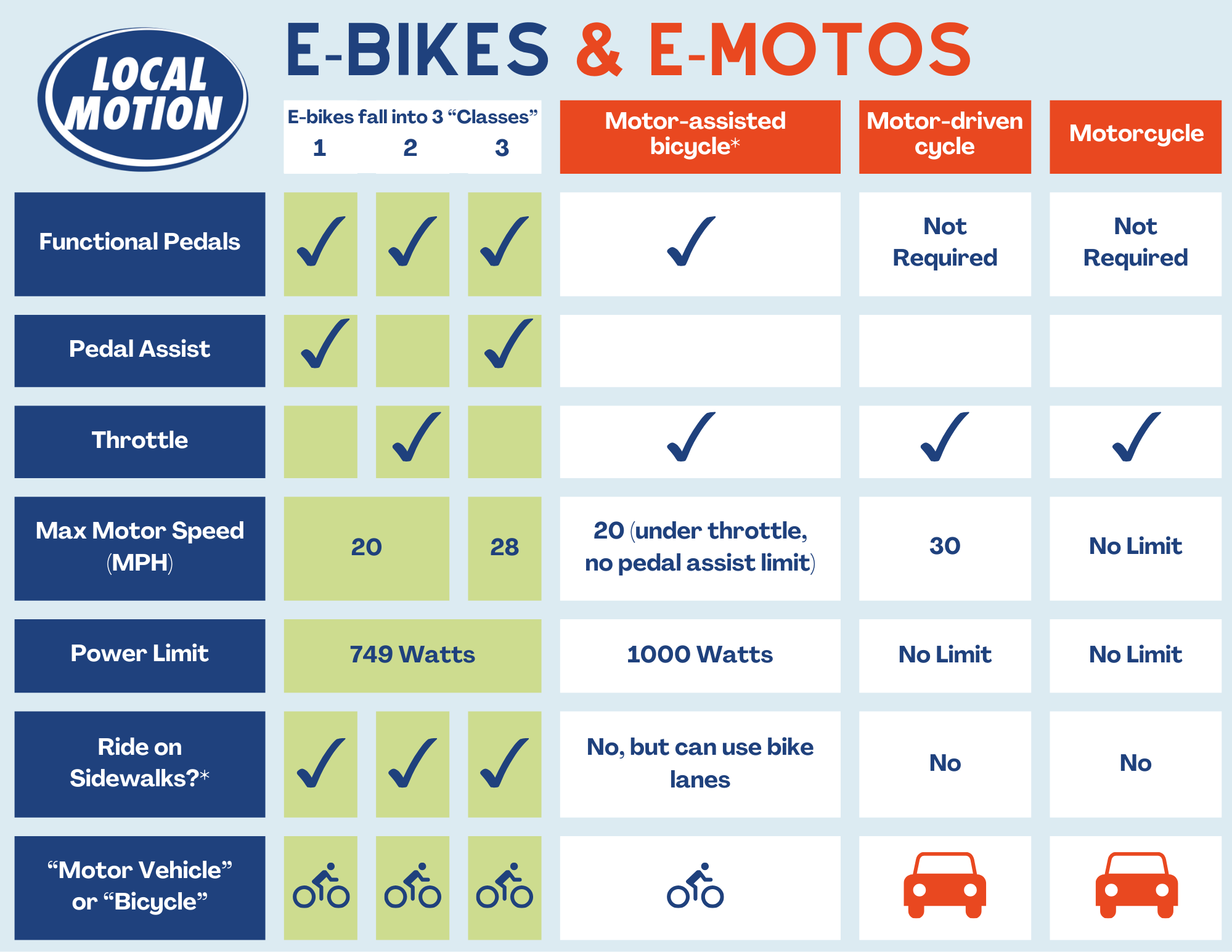
So why are e-motos showing up in our communities? The answer lies in a regulatory gap. The State of Vermont has a well-established e-bike classification system, but currently has little meaningful oversight over the sale and use of e-motos. While generally not sold through local bike shops, these devices are increasingly accessible through online retailers.They are often purposely mislabeled as e-bikes, to obscure their legal status from consumers. At the same time, targeted marketing campaigns are reaching teenagers directly, promoting these devices in ways that emphasize speed, adrenaline, and unsafe riding.
Legally, these devices are motor vehicles. However, e-motos can be purchased online and operated immediately, without oversight from the Vermont Department of Motor Vehicles or other regulatory authorities. In practice, this is allowing a minor to purchase a motor vehicle online and operate it without licensing, insurance, or enforcement. The result is predictable: devices prohibited from sidewalks and shared-use paths are operating there regardless, and existing laws are not being effectively enforced.
Despite this, e-bikes are being misidentified as the problem and are facing new restrictions as a result. This underscores the need to clearly distinguish which devices are actually driving safety concerns. We use the term “e-moto” to describe bike-like devices with significantly higher speeds and power than any e-bike.
Restricting lawful e-bikes in response to illegal e-moto use would be both ineffective and unfair. It would do nothing to address the underlying issue while penalizing the much greater number of Vermonters who use e-bikes legally and responsibly. This would disproportionately harm people who rely on e-bikes for recreation and most importantly accessible transportation, including older adults, teenagers and adults who don't have driver's licenses, people with disabilities, and those who can't afford a car or don't have access to public transit.
Local Motion also acknowledges that e-motos are often used by groups of young people who are outside, physically active, and spending time with friends. This is encouraging to see after decades of declining rates of biking and outdoor activity among children and teens. While there are real safety concerns with e-motos, any response should acknowledge this context. Punishing kids for being active and engaged outdoors is not a solution. The goal should be to redirect their desire to spend time outside towards using safe and legal devices responsibly.
The bottom line: Local Motion calls for:
- Public education to help retailers, parents, and consumers identify and distinguish legal e-bikes from prohibited devices.
- Stronger statewide regulation to close loopholes that allow e-motos to be sold and marketed as e-bikes, including approaches recently adopted in states like California.
- Continued investment in infrastructure to provide appropriate and safe places for e-moto users to ride, separate from pedestrians and car traffic.
- Consistent enforcement of existing laws prohibiting e-motos from sidewalks and shared-use paths.
Community safety is a shared priority. We want people to be outside, active, and connected with one another, but in ways that do not create unnecessary risk or harm to themselves or others. The focus must be on clear rules, consistent enforcement, and targeted action where it is needed most. E-bikes are not the problem. They are part of the solution. Let’s work together to create a community-centered solution to create safer streets for everyone.
E-moto Resources: