
I read most of this book on a bus ride to Boston. I was on my way to my daughter’s wedding. In the speech I prepared for the wedding lunch, I described my daughter running up and down a little hill as we sang "The Grand Old Duke of York." Right at the beginning of The Wind at my Back I came across this passage "That snowy Christmas we endured the long hours of faltering motorway traffic, staring mindlessly at blank fields and filthy cars, singing "The Grand Old Duke of York" over and over again to send our daughter to sleep, munching on turkey sandwiches."
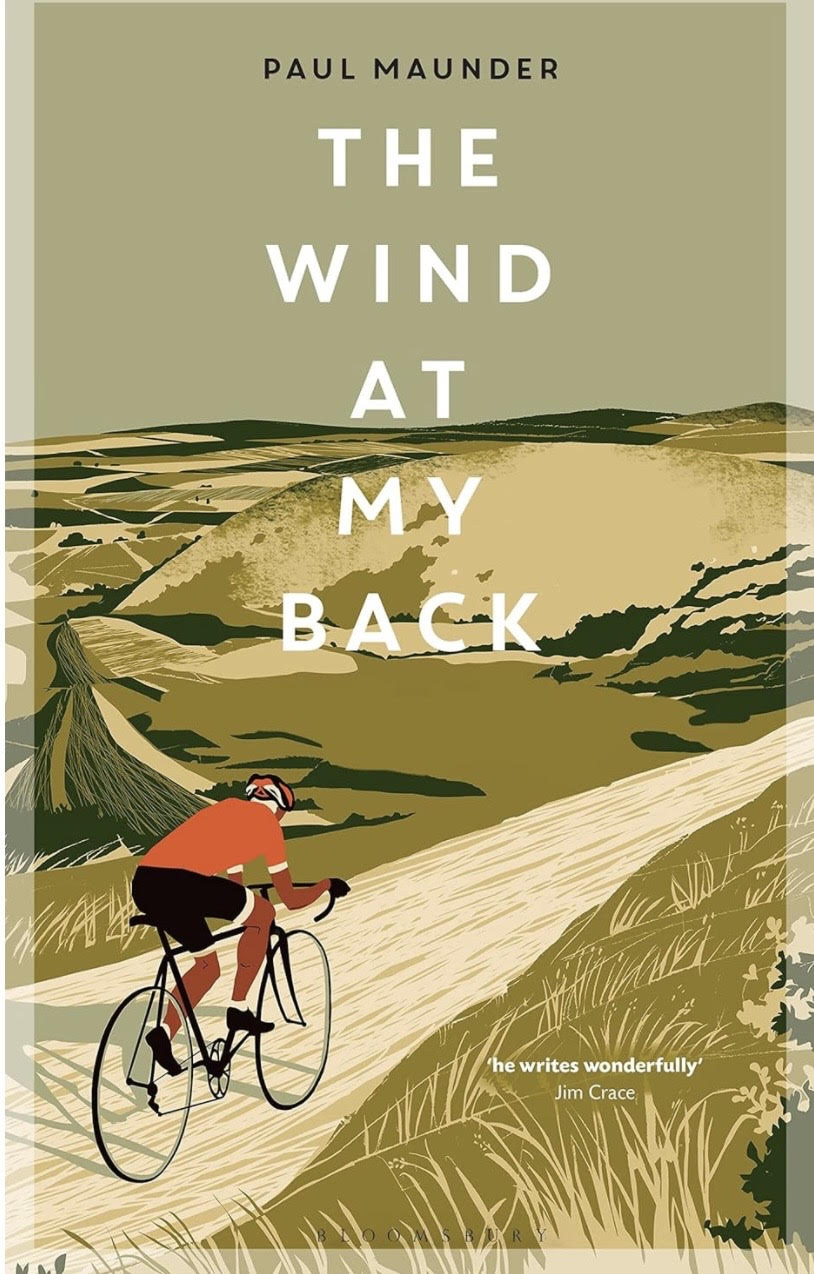 I quote this sentence because of the GODOY but also to comment that this book could have used some strong editing. It might have helped the writer avoid run on sentences! I enjoy it when a book refers to something that is also happening in my life. As I read this book, written by a former professional rider, there were many moments that I identified with including the challenge of riding when you have small children. Maunder goes on a Christmas ride and lists the many kinds of snow and ice encountered by winter riders: “Fresh powdery snow, older hard-packed snow lethal stiff ridges that can send your wheel sliding inwards, friendly slush, traitorous slush turned to ice, invisible ice that covers the road like cling film.” This winter I have experienced many of those snow conditions. I have a fat bike with studded tires, which makes it easier to negotiate many different snow and ice conditions, but on a Sunday in January I encountered black ice on Colchester Hill and had to walk up the hill instead of riding. This has been one of the hardest winters for riding that I have encountered for many years!
Before I was a rider I was a walker. I did a walk long the Southern Coastline of Rhode Island, explored all the roads and footpaths within a days walk of the village of Choponet in France and wandered through the streets of London. Maunder describes the work of Richard Long, who makes his art from walking. "In 1967 a young artist called Richard Long, a student at Central Saint Martins, took a train out of London from Waterloo station. When the train reached open fields, Long got off at the next stop and walked to a nearby meadow. There he walked back and forth until the weight of his footsteps formed a visible line of downtrodden grass. He made a line, a path with a beginning and and end, an imprint in the landscape. He took a photograph of his line and caught the next train back to a London. A Line Made by Walking was to become a seminal work… Walking is central to his work." When I was in London in 1979 I saw an exhibit of Long’s. I sent him a note asking if we could meet. He sent back a note saying that he did not find talking about his work useful. Nevertheless, he inspired some of the performance work I went on to create.
Maunder writes, "When you are led by another cyclist, you give yourself over to their guidance and the mind is freer. The less you know of the terrain, the freer you are because you have no idea what is around the bend." When I lead rides for the Winooski Bike Gang, I enjoy giving participants that sense of freedom. I know the area around Winooski very well and I think that riders can trust me not to get lost. Many times I hear that someone has never been down a rode we have taken. Occasionally I get the same experience when I take a ride led by someone else.
This is from a chapter called Streets. "Click. Since the invention of clipless pedals in the mid-eighties, the sound of a cleated cycling shoe clipping into position has become for me at least, a significant sound. In physical terms it means that one’s foot is committed to forward motion. Psychologically, the sound is a statement of intent." I started using clipless pedals not many years after they were invented. At that time they were hard to get in and out of. More than once I fell down before I clipped out. Now I use clipless pedals all the time, even in the winter. They make me feel more connected to the bike. The hardware at the bottom of the shoes gets caked with snow, so I have to stamp my feet to get them clear.
While Maudner has ridden bikes in many different places he writes, "Another thing every cyclist knows: you never fall out of love with your home roads. They are the neural pathways in your brain, and the arteries leading to your heart."
In the winter, especially this winter, I ride the same short routes over and over again - From Winooski up Colchester Hill into downtown Burlington or up Riverside Avenue into the Old North End. I almost always take Riverside Avenue back home again. Because of the snow and ice, the road conditions change from day to day. During and after a storm I often have to walk my bike for part of the route. In December much of my commute is in the dark, by the middle of February the days are noticeable longer. I can sense spring somewhere over the horizon!
This is from the last paragraph of the book. "I’m interested in loops. Head out, then return. On the bike, on foot, in stories. No need to go far, just keep your eyes open. Our lives are full of loops."
As spring approaches I hope my loops can get a little bit longer!

About the Author: Peter Burns is a long-time bike enthusiast, and one of the original year-round bike riders in the greater Burlington area. In addition to writing about walking and biking, Peter teaches a variety of bike workshops. He also works at a group home for people with psychiatric disabilities, teaches classes for the Vermont Humanities Council, teaches swimming at the Burlington YMCA, and is a regular host of Storytelling VT. You can contact Peter at [email protected].